There is even a cave in a nearby rock outcropping...
And the cemetery across the street is like out of ancient Europe!
The Glastonbury Historical Society held a Springtime Maple Syrup event - I was stationed as a guide in the Eastbury barn but got a chance to observe the maple syrup process from start to finish.
From tapping the sap...
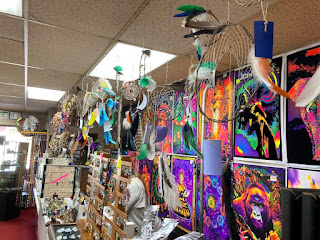
then bringing to a boil...I had busted the drumhead my Doumbek a while back in a drum circle frenzy LINK> and Dean recommended I check out this crazy hippie store in Willimantic to get it fixed. Dean had his amazing frame drum custom built here.
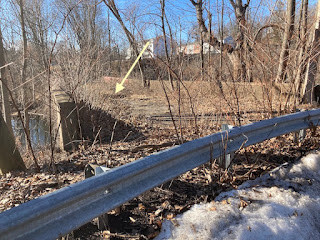
You get a hint of what's isnide by the fire hydrant out front!Built in 1918 the Arrawanna Bridge is one of the Connecticut's oldest bridges and is an early example of an open-spandrel concrete arch bridge. It was listed on the National Register of Historic Places in 2004.
Once part of a major thoroughfare, in 1974 Berlin Street was bypassed to the west and the bridge was closed. By 2003, the bridge was deteriorating in place, with shrubs growing in the roadway.
Its quite a sight to see!
View from the end of Berlin Street...Apparently, Greg likes to use an axe. Every time he comes home to visit, he likes to chop down a dead tree... I don't really care but he is possessed.
July 23rd - Ah my son - Success at a cost...
December 26th - Greg bought an axe to replace what he broke and insisted on chopping down another tree. This time, when it fell, it blocked two of my trails! %#$%#!- Arrg!!! I said "You've gotta clear those trails!!!".
After much sawing (I even helped a bit) he cleared the way once more!
| Before |
South Glastonbury has an incredible history! Old houses dating all the way back to 1748 and old mills and an Indian trading post were all part of this historical tour I volunteered at!
"The community known now as South Glastonbury was originally called Nayaug and was the first part of what would, in 1693, become the separate town of Glastonbury to be settled upon by the founding families of Wethersfield. At first predominantly agricultural in nature, South Glastonbury grew in leaps and bounds beginning in the early 1800s with the development of substantial manufacturing facilities along Roaring Brook. The closing of the mills brought industrial growth and to a halt, and a return to agriculture, most notably in the form of lowland tobacco farms and hillside fruit orchards. While a number of those are still in operation, South Glastonbury is now primarily a low-key commercial and residential community, albeit one with a long and varied history. As a result, the properties that you will be touring are a mixture of colonial, Greek Revival, and Queen Anne styles."